Showing posts with label Asteraceae. Show all posts

Friday, July 16, 2010

Abbott's Lagoon

One of my favorite botanizing spots is Abbott's Lagoon at Point Reyes National Seashore. The terrain is haunting and windswept. The dunes and adjacent scrub covered hills are home to a spectacular array of coastal wildflowers.

San Francisco, particularly the western half of the City, consisted of this ecosystem before the arrival of Europeans. I enjoy looking out over the lagoon and imagining how San Francisco used to appear. Lake Merced, in the southwestern corner of San Francisco, used to be a coastal lagoon similar to Abbott's Lagoon.

Here are some of my favorite images from Abbott's Lagoon:

Grindelia hirsutula var. maritima
Cirsium quercetorum
Chorizanthe cuspidata
Dudleya farinosa
Camissonia cheiranthifolia
Anaphalis margaritacea
Symphyotrichum chilense
Silene scouleri var. scouleri
Monardella undulata var. undulata
Cirsium occidentale var. occidentale
Gentiana affinis var. ovata
Coastal Dunes, Abbott's Lagoon
Plagiobothrys reticulatus var. rossianorum

Tuesday, June 29, 2010

Ring Mountain Open Space Preserve

Ring Mountain Open Space preserve is one of the best things about living in San Francisco if you're a plant nerd. A short 20-30 minute drive across the Golden Gate Bridge and into southern Marin County and you're standing on a small hill surrounded by stunningly beautiful native flowers while enjoying postcard perfect views of San Francisco and Mt. Tamalpais.

San Francisco as seen from Ring Mountain in April
Once upon a time (ohh, say, the 1950s) the urban planners in the Bay Area were busily deciding how to manage the relentless growth the post-war economy brought to the region. One of those unrealized plans had a lovely 6 lane freeway perched along the ridgetop of the Tiburon Peninsula connecting to a new bridge to San Francisco via Angel Island and Alcatraz Island. Ring Mountain, located at the start of the peninsula, was slated to be topped/leveled and a regional shopping mall placed there, with convenient access to San Francisco provided by this wonderful new bridge and freeway.

Mt. Tamalpais as seen from Ring Mountain
Thankfully we had our freeway revolt and this plan never happened. Ring Mountain remained undeveloped and in the early 1970s a spectacular flower was discovered, a species of Calochortus, that would finally seal the deal for Ring Mountain to forever remain open space.

You may be noticing a theme in my blog posts. Serpentine. Ring Mountain is full of it, and in fact, the rarity of many of the flowers found on the mountain is due to the serpentine outcrops found there. Calochortus tiburonensis, Allium lacunosum var. lacunosum,  Monardella purpurea, and more are serpentine species. This lucky happenstance of plate tectonics gives Northern California its full and fascinating flower diversity. The mountain seems to have something interesting in flower from mid-March through June and into July. Let's check out some of the more interesting species and when they bloom:

Calochortus umbellatus, mid-March
Lasthenia californica, mid-March
Dodecatheon hendersonii, mid-March
Tauschia kelloggii, mid-march
Toxicscordion species, mid-March
Leptosiphon androsaceus, mid-April
Sidalcea malviflora var. laciniata, mid-April
Layia platyglossa, mid-April
Achillea millefolium, mid-April
Ranunculus californicus, mid-April
Sisyrinchium bellum, mid-April
Calochortus umbellatus, mid-April
Thermopsis californica, mid-April
Calochortus tiburonensis, late May
Allium lacunosum var. lacunosum, late May
Eriophyllum confertiflorum var. confertiflorum, late May
Hesperolinon congestum, late May
Castilleja rubicundula ssp. lithospermoides, late May
Delphinium hesperium ssp. hesperium, late May
Silene californica, late May
Triteleia peduncularis, late May
Monardella purpurea, mid-June
Clarkia rubicunda, mid-June
Dudleya cymosa, mid-June
Eriogonum luteolum var. caninum, mid-June
Hemizonia congesta ssp. lutescens, mid-June

Tuesday, June 15, 2010

Bibb County Glades - a botanical wonderland

Through a Flickr contact in Minnesota, Dr. Brian O'Brien at Gustavus Adolphus College, outside of the Twin Cities in Minnesota, I learned of a very special botanical preserve in Alabama, the Kathy Stiles Freeland Bibb County Glades Preserve, located 90 minutes southwest of Birmingham. 

Cedar Glade - notice the forest ends abruptly
where the ultramafic soil begins?
This spectacular botanical wonderland was undiscovered until 1993, when a fish biologist and botanist went on a canoe trip to survey the Little Cahaba River.  What they found astounded them: 8 new species of plants and several others that had not been seen in decades, one of which was presumed extinct. Species of Castilleja, Liatris, Onosmodium, Silphium were all found to be new to science!
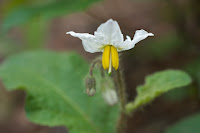
Solanum pumilum, a new record for
this species in Alabama
I had to visit this place! I grew up in the suburbs of Birmingham and return infrequently to visit family. My last return home in May 2009 I made plans to visit the Bibb Glades. It rained 4 of the 7 days I was in Birmingham but I was determined to make it to the Glades, so I headed off one morning in a drizzle that thankfully was gone by the time I reached the glades. I'd forgotten about the humidity and mosquitos of Alabama, though, which made the visit that much more interesting.
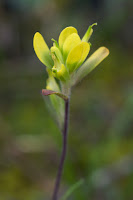
Castilleja kraliana, new
species to science
Briefly, the glades are special because of their soil. A particularly pure form of limestone, Dolomite, is found at the surface of the earth here. This limestone weathers into a soil that is toxic to most but not all plants, known as ultramafic. The mixed broadleaf-pine forests that dominate most of Alabama cannot grow in this soil. This leaves a large opening in the forest canopy and a fascinating mix of ultramafic-tolerant plant species.
Leptopus phyllanthoides
The place was simply amazing. So much of Alabama has been farmed, developed, planted, etc. that everything you see that's green and growing is disturbed by human touch. About the only native plants left are the trees. Walking through the Bibb Glades I felt like I was really back in a place and time very few people have experienced, particularly in such a developed area.

Marshallia mohrii, a previously
undiscovered population and the
plant that alerted the botanist
there was something special on
the Little Cahaba River
The glades are now owned by the Nature Conservancy and are open to visitors during daylight hours. Click on any of the photos in this post to see the incredible diversity of plants I encountered and photographed at the Glades that day.